almost 1 in 7 adults now ‘under the protection’ of the OPG
The annual report of the OPG (Office of the Public Guardian) for England and Wales may not be near the top of most people’s summer holiday reading list. But it comes out each year, usually in July, and over the years it reveals some of the shifting issues and priorities that the organisation has been facing.
This blog post reflects on the information the annual reports do and do not report, and reflects on what this may reveal about the current priorities of the organisation.
Despite the primary purpose of the OPG (alongside with the Court of Protection) to protect those who lack mental capacity, it is surprising how little of their annual reports actually focus on the protection of those who lack mental capacity, and the scrutiny of those who have significant powers delegated to them, such as LPA attorneys.
In recent annual reports, the recurrent challenges have been: how to process the growing number of applications for Lasting Power of Attorney (LPA); how to retain and recruit a stable workforce, and; how to balance the books. For example, some key performance indicators it reports for 2025-26 include:
- 1,589,500 lasting power of attorney applications received
- Average working days for clearing LPA applications (= 45 days)
- Percentage of customers satisfied with power of attorney services (85%)
- Cost recovery (income as a % of expenditure) 103.4%
Only two performance indicators relate to safeguarding risk assessments and investigations of safeguarding concerns, and these relate to the time to carry out such risk assessments (target 80% within 2 days, actual 85%) and the average time to conclude investigations (target 35 days … actual 198 days).
In contrast to the OPG’s other customers it seems that people who raise safeguarding concerns, including those whose concerns lead to OPG investigations, are not asked whether they found the service helpful or not.
Counting forms processed and registered – not people
Another unusual – peculiar even – feature of the OPG annual reports is that they mainly report their activity in terms of the number of application forms received or agreements registered. Nowhere, currently, do they state the actual numbers of people who have been appointed as LPA attorneys or deputies or – most importantly – how many LPA donors currently exist.
Given that the safeguarding of LPA donors is one of the main purposes of the OPG, why doesn’t the OPG routinely report the number of people whose best interests are meant to be served by them?
So how many LPA donors are there?
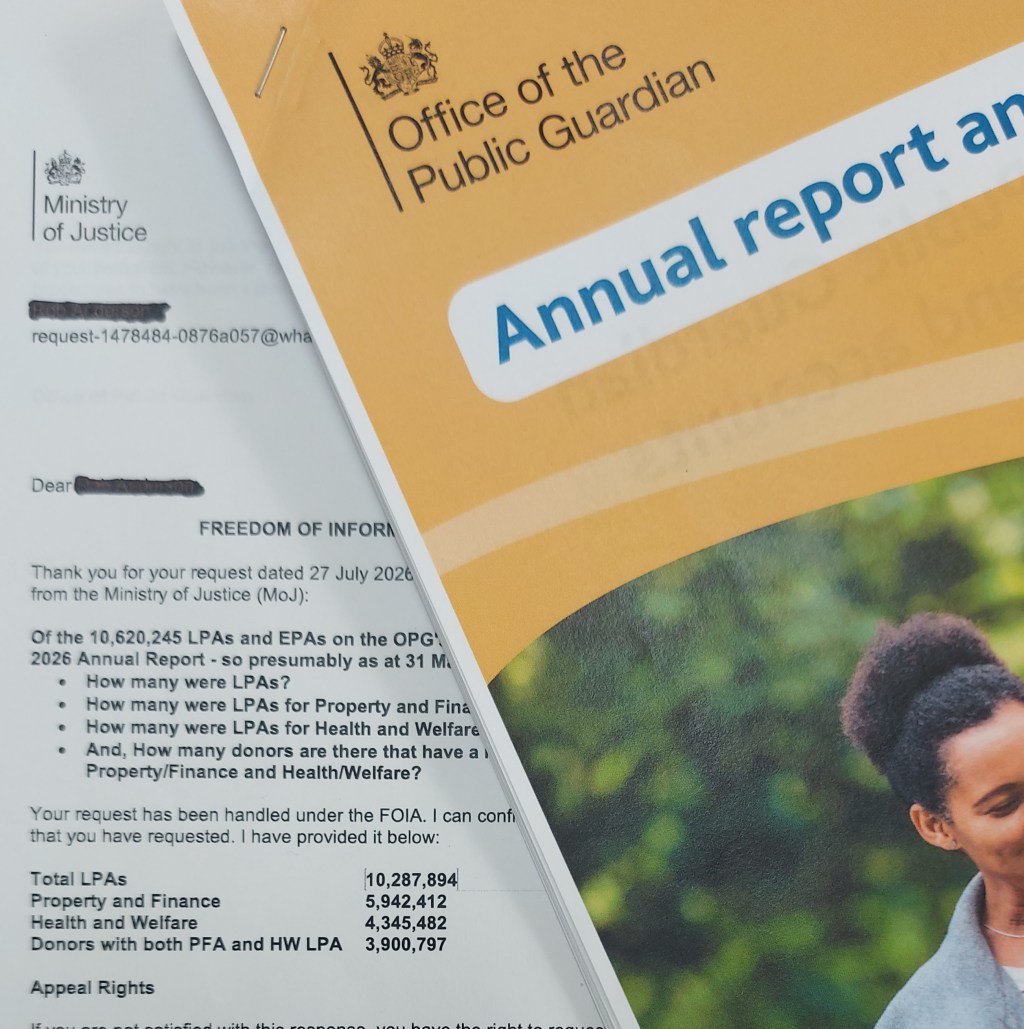
For this reason, I made an FOI request to obtain this information. The OPG’s response shows that of the 10,287,894 total registered LPAs (as at 31 March 2026):
- 5,942,412 were LPAs for Property and Financial Affairs
- 4,345,482 were LPAs for Health and Welfare
- 3,900,797 people had LPAs for both Property & Finances and Health & Welfare
From these figures it can be worked out that, in total, at the end of March 2026 there were 6,387,097 people (donors) ‘under the protection’ of the OPG, who had appointed LPA attorneys. This means over 13% of the adult population* in England and Wales have appointed LPA attorneys – or almost 1 in 7 adults.
(*using ONS mid-year population estimates of those aged 20 or over for 2025).
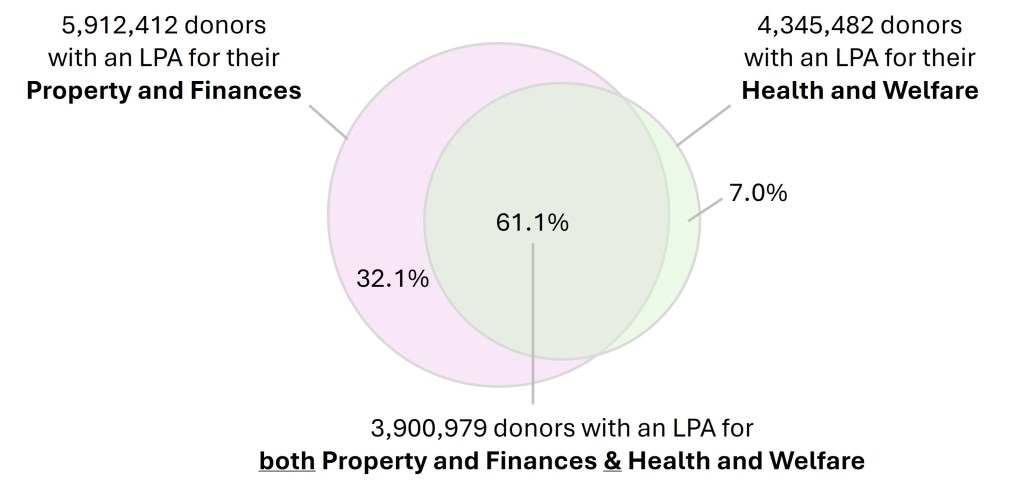
(Source data: 2026 FOI request to OPG)
This data also shows the numbers and proportions of people who have chosen to create each type of LPA: either only for Property and Finance (32% of all registered donors) or only for Health and Welfare (7%) – or for both LPA types (61%).
Given the critical importance of both types of decisions that LPAs can cover, it raises questions about why so many people – around 2.4 million to date – have chosen to create one type of LPA but not the other.
But this is changing over time. It is interesting that of the 716,413 new donors, who created LPAs during the year 2025-26, over three-quarters of them chose to appoint attorneys to manage both their Property and Finance and Health and Welfare if they lose mental capacity. While only 5.5% of new donors chose to appoint an attorney(s) only for Health and Welfare decisions, this is still almost 40,000 people (see Fig.2).
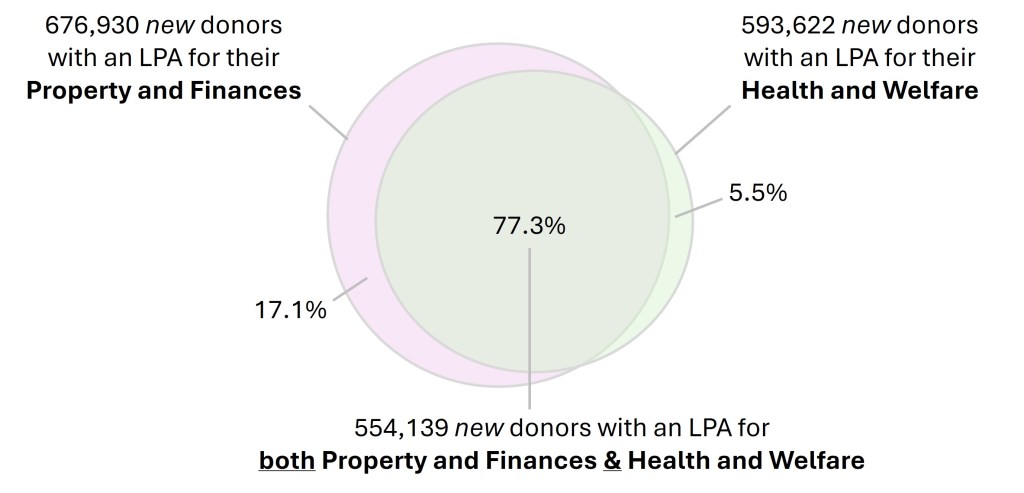
(Source data: 2025 and 2026 FOI requests to OPG)
Customers, cost recovery and Chief Executives
Over the years the language in the annual reports has changed too, especially becoming more corporate and customer-focussed – in recent years the opening summary statement is from the Chief Executive and Public Guardian (no longer simply the Public Guardian). This gives the unhelpful impression that the OPG operates primarily as a business, rather than a public safeguarding agency (as an arm of the Ministry of Justice).
In any public service or organisation focused on safeguarding or justice, a growing emphasis on customer satisfaction and service improvement is of course to be welcomed – it’s good news that the time to check and register an LPA is the shortest it’s been since before the Covid-19 pandemic. Full scrutiny in approving such critically important legal arrangements is hugely important – not least because there are few other safeguards at the time when LPA applications are created and signed (NB. Unlike in Scotland, in England and Wales, the so-called ‘certificate provider’ does not need to be anyone with recognised qualifications or skills in either assessing mental capacity, or discerning the signs that someone may have been manipulated into choosing their LPA attorney(s)).
Arguably the most important customers of the OPG are the LPA donors themselves – all 6.3 million of them, especially those among them who have lost mental capacity. However, a key ally to the OPG in preventing and stopping the abuse of donors is also any person who raises genuine concerns about the actions or behaviours of an attorney.
They are surely key stakeholders, to be supported and listened to? They are both allies in the protection of vulnerable individuals and key recipients of the OPG’s advice on how to report abuse, and gather evidence of suspected abuse.
So, how could the OPG be more transparent as a public safeguarding agency?
The balance of information provided in the OPG’s recent annual reports, from the Chief Executive’s opening statement to the choice of reported key performance indicators, has become highly corporate and too focussed on its ‘sales figures’ – the processing and registration of new applications. Perhaps as a consequence, the focus on the real ‘customers’, whose interests should be guarded– LPA donors, and others with appointed Deputies or guardians – has been diminished.
Instead, to present itself better as a publicly funded and statutory safeguarding agency, the OPG annual reports could:
- Report annually the number of registered LPA donors of each type – to better emphasise the number of potentially vulnerable people involved, not just the number of legal forms registered or applied for. Since in recent years the OPG has been so successful at promoting the uptake of LPAs, the focus of the organisation should shift to how to better protect the growing number of people under its protection – now numbering over 6.3 million with LPAs. This might also stimulate interest from the OPG into why so many donors only choose to create one type of the two types of LPA.
- Expand its performance indicators to more fully recognise the role of safeguarding concern-raisers as a key ally in safeguarding LPA donors. Rather than just measuring response times, this should include follow-up satisfaction surveys (as happens with the OPG’s other customers) about whether people who raise safeguarding concerns feel that the OPG advice or actions have helped – and if not, how. Anecdotally, based on a preliminary survey, and a growing Facebook campaign group, satisfaction with how the OPG handles such concerns is very low – so low, in fact, that people who suspect the abuse of a loved one at the hands of an LPA attorney may not bother reporting those concerns to the OPG at all. Then it becomes an even more hidden and uncounted problem than it already is.
- Provide fuller statistics on both the sources of concerns raised, and more detail on what happens to those concerns not investigated by the OPG. In previous years (e.g. 2013 and before), the OPG annual reports used to provide a breakdown of the types of concern-raisers and safeguarding referrals received. It is unclear why they stopped publishing this useful information – especially as it underlines how the OPG collaborates with other safeguarding agencies (a laudable priority of the organisation in recent years). At the same time, the OPG should collate and publish the main reasons that it chooses not to initiate an investigation – both in terms of how (sometimes) concerns fall outside the OPG’s legal remit for investigation, if there is insufficient evidence, and/or when other agencies may have stronger powers to investigate. Such transparency and detail could perhaps restore some public confidence in these triage and risk assessment processes (beyond the few brief examples of cases that the OPG annual reports already include).
This in turn might foster more constructive dialogue and mutual understanding among those organisations and individuals who should be allies in identifying and preventing the abuse of vulnerable adults. At the moment, the apparent dominance of its fee-generating activities (i.e. new LPAs), and the perceived secrecy* and defensiveness of the OPG about ‘when LPAs go wrong’ and ‘why they do not investigate’, risk undermining public confidence in its role as a statutory safeguarding agency.
*e.g. Some key information, as this Blog post shows, is still only available by making FOI requests. That said, recent Blog posts from the OPG, including one in January 2026 describing Investigations at OPG are a step in the right direction for greater openness and fuller recognition that LPA arrangements can and do go wrong.
Declaration of personal interest: In early 2018 the author of this Blog reported valid concerns to the OPG safeguardung unit about the erratic actions and dishonest and cruel behaviours of an LPA attorney towards their donor. At the time, these were deemed to not meet the criteria for investigation by the OPG; but from that point onwards my siblings and I knew that this LPA attorney was capable of almost anything. Before my relative died, but as their dementia progressed, the LPA attorney in our case went on to cruelly abuse my relative and to steal or misspend over £200,000 of their money. I firmly believe that had the OPG acted (investigated) when we asked for their help, the abusive attorney could have been deterred from abusing their position of power and trust – and a huge amount emotional pain and stress, and substantial legal costs, could have been avoided.


Leave a Reply