Diverse cases but shared patterns

The first AbuseByLPAs Blog post explored what we know (and don’t know) about the scale of abuse by LPA attorneys. This second Blog post seeks to shed light on the nature and reality of abuse by LPA attorneys in the UK. It asks questions such as:
- Who are the victims of LPA abuse? Are they men, women, and how old are they? How were they vulnerable to abuse?
- Who are the perpetrators? How were they related or connected to their abuse victims? Were they the victim’s sole LPA attorney?
- What kinds of abuse did they commit? Do some types of abuse commonly occur together? and …
- How did the abuse get discovered?
Investigating society’s hidden problems
For all sorts of reasons, abuse by LPA attorneys is one of the most hidden forms of abuse of elderly or vulnerable people. Even when abuse by LPA attorneys is suspected and reported – for example, to the OPG, the police, or to Adult Social Services – there are many factors that mean it may never get fully investigated or appear in published data.
For example, even where the OPG investigates, the details of these investigations are never made public or summarised in anonymised form. Furthermore, although court cases are public, there are high standards of evidence needed to bring a criminal charge of fraud, and to convince a jury ‘beyond reasonable doubt’. And if seeking justice via civil courts to recover funds from an LPA attorney who abused their donor, most cases get settled out of court. Furthermore, LPA attorneys can use their considerable powers (along with their duty of confidentiality) to conceal their actions and to legitimise counter-allegations against those who raise suspicions of their abuse.
For these and other reasons there is little reliable information in the public domain about the nature, reality and impacts of abuse by LPA attorneys.
However, there are two sources of evidence that can shed some valuable light on the nature of abuse by LPA attorneys:
1. News stories in the national and regional press
A search of the Nexis database of news stories identified 24 separate cases of LPA abuse from January 2022 to January 2025. Most of these were based on reporting of criminal court cases, in England, Wales and Scotland – typically of the LPA attorney for Fraud by Abuse of Position.
2. Survey of elder abuse to inform parliamentary campaign
A short (9 question) survey about experience of elder abuse was created for the BBC in February 2024, after the public response following media coverage of the story of Vincent Stephens. It was then distributed by the BBC to all who contacted them or the Daily Mail in response to this story. In April 2024 the survey was distributed again by the office of MP Fabian Hamilton (in support of his Power of Attorney Bill).
By end of January 2025, forty-eight responses were from people who had witnessed or had direct experience of abuse by LPA attorneys. While this is still a small sample – a review of their responses provides a unique insight into the current, varied experience of this type of abuse in the UK .
The survey is still live – if you have not completed it already, and are familiar with a case of LPA abuse that has affected you, please complete the survey – it is totally anonymous and does not take long.
What types of abuse do LPA donors experience?
Of the 48 people who responded to the survey about elder abuse, and reported that the abuse was by an LPA attorney, the dominant type of abuse was financial abuse (see Fig. 1 below). However, this very often occurred alongside psychological abuse, or counter-allegations (e.g. against the concern-raiser or other family members), or both.
Over half (25/48) experienced both financial abuse and pychological abuse, and over two fifths (21/48) experienced all three types of abuse surveyed here.
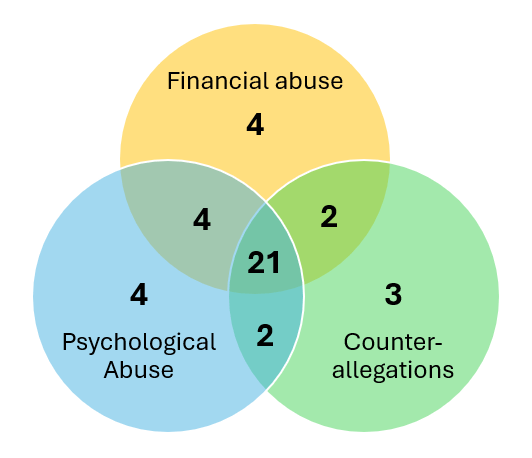
This overlapping occurrence of abuse suggests that when psychological abuse of the donor is witnessed, or counter-allegations are made by the LPA attorney, there should be heightened suspicion that financial abuse may also be taking place.
In short, in the context of abuse by LPA attorneys, financial abuse infrequently occurs in the absence of other (more observable) types of abuse. What this small ‘cross-sectional’ survey unfortunately cannot reveal, is which types of abuse typically started first or the direct and indirect impacts of the abuse.
Types of LPA abuse covered in news stories
Cases of LPA abuse that get covered by national and regional news outlets tend to be from the reporting of criminal cases. All but one of the 24 news stories related to financial abuse, although several also mentioned forced isolation from family, and the suspected fraudulent initial creation of the LPA.
When the scale of the alleged financial abuse was reported in these court cases – with the LPA attorney typically being charged with Fraud by Abuse of Position – it ranged from £7,000 to £600,000. Of the 22 news stories that stated the amount of the alleged fraud or theft, in 11 the amount stolen or misspent by the attprney was over £100,000.
The fact that these stories only occasionally mentioned other (non-financial) types of abuse, probably mostly reflects that these were court cases about fraud, and were also usually reported in very short newspaper articles.
Who were the perpetrators of LPA abuse?
In the news stories reviewed, in over half (13/24) the perpetrator was a family member or relative, as well as being the victim’s LPA attorney. Sons (x 5) and daughters (x 2) were the most common blood relation to have abused their relative.
In one case, both elderly parents (77 & 75 years old) were financially abused to the value of £117,000 by their son and daughter-in-law. And in another, three relatives together were found to have stolen or misspent £145,000 from a victim in Cheshire. However, in general across these 24 cases, it was a single abuser (and typically their sole LPA attorney) financially abusing a single victim.

NB. Larger words in the word cloud reflect more frequent occurrence.
Where the perpetrator was not a relative of the abuse victim (and where reported), they had known them in a wide variety of ways: as their neighbour, lodger, friend, carer, financial adviser, or solicitor. The depressing truth, from even this small sample of news stories about financial abuse by LPA attorneys, is that someone in almost any position of trust or influence may go on to abuse their donor. This includes people in significant professional positions of presumed trust, like solicitors and carers.
In contrast, the age of perpetrators (where reported) was less varied – in the vast majority of cases the financial abusers were in their 50s or 60s (at least, by the time they were in criminal court). This is one of the most consistent patterns to be revealed by this small set of data.
Who are the victims of LPA abuse?
Perhaps unsurprisingly, both the survey and the review of news stories reveal that the victims of LPA abuse are dominantly older people. Of the 48 victims of LPA abuse described in the short survey, 38 were aged over 75 years. The same pattern was revealed in the financial abuse cases reported in the news stories, with the youngest reported victim age being 69.
Men and women seemed similarly vulnerable to LPA financial abuse (in the review of news stories); 12 women and 8 men were victims in these cases, as well as three cases where the victims were a couple (man and a woman). [NB. The survey did not ask about the sex of the abuse victim]
How often do fraudulent wills and predatory marriage occur alongside LPA abuse?
The online survey provides the first data showing the extent to which these three strategies are exploited to gain control over people’s lives and/or their money and assets. Fig. 3 (below) reveals the shocking extent to which abuse by LPA attorneys appears to occur in combination with abuse of wills (such as fraudulent or forged wills). This is especially worrying given that LPA abuse is often (according to solicitors) only discovered by the executors of wills after the death of the abuse victim; but this can obviously only happen when the will executor(s) and the LPA attorney are different people.
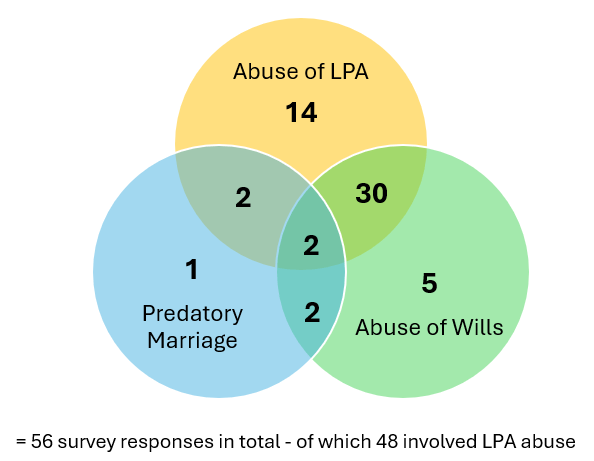
While, among these survey respondents, predatory marriage seems less prevalent, where it did happen it typically (6 out of 7 cased) happened in combination with these other strategies for gaining control over another person’s life and finances. It further underlines that people who have failing mental capacity, or who are vulnerable to manipulation due to other issues of health or loneliness, can be targetted in multiple ways.
It also means that all Registrars – as well as care professionals and solicitors – need to have the appropriate training and vigilance to spot the subtle signs of manipulation and ‘undue influence’ (as was thankfully the case in Vincent Stephen’s story) – and then act to stop marriages where they have doubts about someone not understanding what they are committing to.
How were the cases of LPA abuse discovered?
The review of 24 news stories, mostly of financial abuse when it reached court, sometimes revealed details of how the abuse was suspected or discovered. While, in hindsight, there had sometimes been earlier suspicions of abuse, the firmer evidence of probable financial abuse arose when:
- Will executors sought to confirm bank accounts/estate
- Non-payment of care home fees
- Other daughter noticed funds missing
- Victim received a letter from a debt collector
- Unpaid mechanic’s bill
- Abuser’s law firm received a copy of the client’s (i.e. LPA donor’s) bank statement
- When social services and another family member took over the care of the victim
- A neighbour who grew suspicious of the financial adviser, plus the victim grew scared of staying in their own home
- Care home noticed that their resident could not afford to buy clothes
Alongside these varied triggers for suspecting abuse, it is notable how many of this small review of (mostly criminal, financial) cases also involved some degree of forced isolation of the victim – whether physically and secretively, sometimes moving them to another part of the country – or psychologically, by restricting the ability of family members and friends to visit or speak freely with their loved one (e.g. taking their phone away, or changing the locks on their house).
In summary …
This small survey and review of recent cases in the news provides a preliminary but still deeply concerning picture of the nature of abuse by LPA attorneys. While the detail of the vulnerabilities, perpetrator motives, greed, cruelty, family dynamics, and personal impacts of each case and story are unique – and often remain untold – there are also some recurrent patterns.
While the victims were often older people, and many were in their 80s or 90s and/or had some level of dementia, they were often vulnerable for other reasons too; physical frailty, mobility problems, learning difficulties, partially blind and deaf, or simply anxious about living alone. Men and women – and even couples – seemed similarly likely to be victims of LPA abuse.
The perpetrators were often in their 50s or 60s, but otherwise they were in (or came into) their victim’s lives for a very wide range of reasons, and only around half were relatives. While it is impossible to know their true motives, or how the abuse started, court case reporting revealed that some had money and addiction problems. They were also often (perhaps by intention?) the victim’s sole LPA – closing down one important mechanism of potential scrutiny and oversight (i.e. having more than one LPA attorney).
Perhaps the most useful insight from these basic analyses is the degree to which LPA abuse rarely happens in isolation from other types of suspected abuse. When manipulative perpetrators gain control over another person’s bank accounts and assets (with an LPA), they may frequently seek to benefit by also becoming executor and/or beneficiary of the will, or by emotionally manipulating vulnerable people into marriage. Similarly, while evidence in the public domain is dominated by news stories of financial abuse, the online survey of LPA abuse shows that financial abuse, psychological abuse – and counter-allegations, typically of the very friends or family who have witnessed or suspected the abuse – commonly occur together.
Finally, neither the survey nor the review of news stories can fully reflect the diverse and horrific impacts of LPA abuse, both directly on the victim, and indirectly on their wider group of family and friends. They are inevitably selective snapshots, and recollections of events, evidence and actions after the story of abuse has been pieced together – whether by the police and lawyers, or by the executors of wills and other family members.
They therefore only reveal small glimpses of how the abuse may have started, what motivated the perpetrator, how the victim was vulnerable, what missed opportunities their were to identify and deter/catch the abuser, and so unfortunately they give limited insights into how it can be better prevented in the future.
Conspicuously, despite the prevalence of psychological abuse by LPA attorneys (among those who have financially abused their donor), and the apparently common use of forced isolation of the donors by abusive LPA attorneys, there are very few news stories, and no(?) court cases relating to the abuse of Health and Welfare Attorney LPA arrangements.
I welcome any comments or suggestions on this Blog post – please Comment below. Or please page up to the button above to complete the survey of LPA abuse experiences.
 AbuseByLPAs.net
Leave a comment